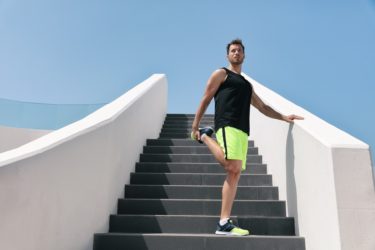
Stairs for better health?

Posted in Exercise Training on August 26th, 2010 by admin – Comments Off

Take the stairs or take the escalator? Here is one choice often faced and this lifestyle choice can greatly affect your health in the long-term.

The benefits that one can see by simply taking the stairs up to the office or up to the apartment are outstanding. Bone health, muscle strength, balance, energy use and heart and blood vessel health are all health related factors which benefit from ‘taking the stairs.’

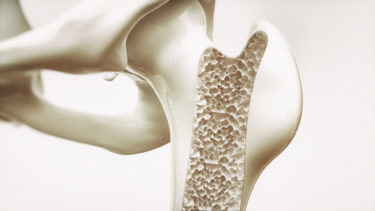
The repetitive impact and forces placed on the body stimulate the bones in the legs, hips and spine to have a higher turnover of bone which can increase bone mineral density or at least help maintain what is there. Lifting the body up on one leg, again in a repetitive fashion, causes muscle activity through the lower limbs and hips which improves strength. There is a technique to help you step up stairs which optimises the benefits; push down through the heel and squeeze the bottom of the working leg. Taking a period of time on only one foot challenges your body’s awareness of itself in space and improves balance.

All of these factors together cause an increased blood flow and, depending on fitness level and the amount of stairs taken, will raise the heart rate. This improves the health of the blood vessels as well as the most important muscle in the body – the heart. Ultimately, the use of stairs as opposed to an elevator causes increased energy expenditure. There is a drastic difference between standing still in the elevator versus taking the stairs and often this simple lifestyle change is enough to tip the scales and promote weight loss.

Strength Training

Posted in Exercise Training on June 28th, 2010 by admin – Be the first to comment

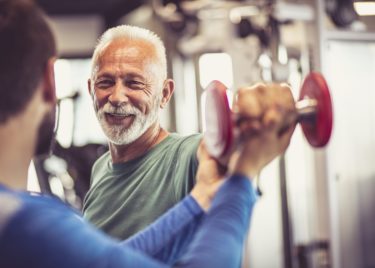
Strength training is the use of resistance (whether your own body weight, thera-bands or weights) to produce a muscular contraction in order to build strength, anaerobic endurance and size of skeletal muscle.  Strength training is an important part in any individuals exercise routine.  Consultation with an Accredited Exercise Physiologist before implementation of a strength training program is crucial.

The benefits of strength training do not only rest with ‘toning’ up, there are a number of positive health benefits that you will receive from a regular strength training session, which include;

  • Increase in both muscle strength and mass.
  • Increased resting metabolic rate – aiding in weight loss and maintenance of a healthy body weight.
  • Improvements in muscle imbalances.
  • Reduces resting blood pressure.
  • Assists in prevention of diabetes.
  • Increased Bone mineral density (therefore a reduced risk of osteoporosis).

Resistance training will have positive effects upon your body, your self esteem and your self confidence.  Implementation of strength and conditioning training program into a weekly exercise routine can be completed by any person at any age, with the correct guidance from a Exercise Physiologist.  In all cases strength training can be enjoyed and performed safely with the correct technique and supervision.

If you have any questions or would like any information regarding postural strengthening please give me a call at Bodytrack Health and Fitness Studio Brisbane.  07 3870 4119 www.bodytrack.com.au .

Exercise for Lower back pain

Posted in Exercise Physiology on June 17th, 2010 by admin – Be the first to comment

Lower back pain is possibly the most common complaint in today’s society and there can be any number of reasons for its occurrence. If there was no particular time in which a particular movement or a traumatic injury caused lasting pain then the problem is likely to be a result of muscle imbalances if it’s not genetic or structural deficiencies. The typical cause of this back pain is the presence of tight muscles along the spine, hips and back of the leg, combined with weak and inactive core and gluteus muscles. Exercises that reactivate the gluteus muscles, combined with various stretches, often have positive results. It is ideal to have a proper musculoskeletal assessment performed by a Physiotherapist or an Exercise Physiologist to determine what particular muscles are tight/ weak/ overactive to determine an appropriate approach to remedying the pain. For further information on exercises for lower back pain, please call Bodytrack Health and Fitness on 07 3870 4119

Cancer: how an Exercise Physiologist can help during and after treatment.

Posted in Exercise Physiology on June 11th, 2010 by admin – Be the first to comment

For many years exercise has thought to be a contraindication (not recommended) for cancer patients. Over the past decade, research has found that exercise is beneficial both during and post cancer treatment, with improvements in psychological and physical health as well as compliance with treatment. Evidence has shown that correct exercise with a planned program from an Exercise Physiologist can reduce the impact of symptoms and treatment-related side-effects, with improved survival for particular cancers such as prostate, breast and colon cancers.
Cancer patients undergo a tumultuous few years following the day they are told of their condition. Soon after the onset of radiation or chemo-therapy comes the range of treatment-induced symptoms. Not only can the treatment regime be very debilitating to the patient’s physical health, but their mental health suffers as well. Many patients feel like fate is ‘all-controlling’ and they have no say in the events of their own life.
Exercise can significantly improve both the physical and mental health of the patient. Firstly, many treatment-related symptoms can be alleviated with a carefully prescribed program. The noteworthy benefits are seen in maintaining and/or improving hypertension, improving tiredness and maintaining functional capabilities that might otherwise have become a problem.
Mental health is one other significant benefit that has been supported by an exercise regime. Patients feel an overwhelming lack of control; however patients who undertake an Exercise Physiologist prescribed program show significantly improved mental health markers. Many report that in all the craziness that surrounds cancer treatment; their exercise program is theirs and theirs alone to control. It is also proven that a reduced incidence of depression, anxiety and stress are significant benefits resulting from regular exercise.
The health benefits related to exercise in the general population can be translated to the cancer patient and cancer survivor population. Exercise can reduced the risk of many diseases, many of which can often surface during cancer treatment, including Cardiovascular Disease, Hypertension and Type 2 Diabetes. Thus, the exercise not only boosts their chance of survival, but can enhance the longevity of their life post-treatment, and an Exercise Physiologist is the best person to talk to about how exercise can help.
Current exercise recommendations are low to moderate intensity exercise with regular frequency. To find out more about the appropriate exercise measures please talk to an Exercise Physiologist at Bodytrack Health and Fitness on 07 3870 4119.

Exercise Physiology

Posted in Exercise Physiology on June 11th, 2010 by admin – Be the first to comment

Exercise physiology is the study of the human body under stress and during exercise and the application of this science to improve the body’s function. Through the delivery of exercise, lifestyle and behavioural modification programs, Exercise Physiologists specialise in the prevention, rehabilitation and management of chronic conditions and musculoskeletal injuries.

Exercise Physiologists have completed a four year degree in Applied Science (Human Movement Studies) which includes extensive study of the anatomy, physiology and biomechanical function of the human body as well as an understanding of the benefits of exercise. This course differs to Personal Training courses due to its heavy focus on science and evidence-based research in the application of exercise programs. That is, Exercise Physiologists are able to provide not only personal training for general population, but also design appropriate programs for people with chronic conditions such as cardiovascular disease, diabetes, osteoporosis, depression, cancer and chronic injury or pain.

With this extensive scientific knowledge, Exercise Physiologists are able to tailor programs to provide a range of services, including personal training, sport-specific strength and conditioning, injury prevention, musculoskeletal rehabilitation, disease management, postural control and pre- and post-natal conditioning.

Exercise Physiologists work alongside other allied-health professionals, such as physiotherapists, massage therapists, podiatrists, dieticians, occupational therapists, psychologists, chiropractors and occupational therapists, to achieve the best possible results with all clients.

While Exercise Physiology is only new to the allied-health scene, a number of private health funds offer cover for the service. Additionally, with a doctor’s referral, DVA members and people with type 2 diabetes or chronic conditions (6+ months duration) are able to claim up to five sessions per year with a Medicare Enhanced Primary Care (EPC) program.

Bodytrack is an exercise physiology studio based in Toowong, Brisbane, which provides all of the services mentioned above. All staff employed at Bodytrack are Accredited Exercise Physiologists with extensive knowledge and practical experience. Bodytrack also provides the knowledge and services of a massage therapist and a highly qualified physiotherapist.

Gym with a difference

Posted in Gyms on June 11th, 2010 by admin – Be the first to comment

Bodytrack offers professional Exercise Physiology services in a clean and spacious air-conditioned gym surrounded by fresh leafy outlooks. The Bodytrack gym offers all of the equipment of a regular gym as well as extra apparatus appropriate for postural and balancing exercises. However, unlike a regular gym, you will never be waiting for equipment, as the Bodytrack gym is used, on average, by only 1-4 people at a time.

The Bodytrack gym provides equipment suitable for whatever your exercise goals are; whether this may be general fitness and strength work, rehabilitation of an injury, post-natal reconditioning or postural strength and stability. The staff at Bodytrack gym are all accredited Exercise Physiologists and have the extensive knowledge and experience required to help you achieve your exercise goals. Unlike personal trainers found in regular gyms, the Exercise Physiologists at Bodytrack have completed a four-year university course as well as practical experience in appropriate exercise prescription, thus providing you with the highest quality service.
The Bodytrack gym is suitable for one-on-one training with our Exercise Physiologists as well as group sessions and circuit training, with a wide variety of cardio and weights equipment. We welcome all clientele, including elite athletes, people with chronic injury or disease, soon-to-be and new mums and corporate groups, and all staff have the scientific knowledge required to prescribe exercise to all of these groups.
Located in the west Brisbane suburb of Toowong, the Bodytrack gym is easily accessible, with free undercover parking or shaded street parking. So whether you currently attend a gym or are looking to start a new exercise program, contact Bodytrack today to find out how our staff and gym can help you achieve your goals!

Personal Trainer Brisbane

Posted in Exercise Training on January 22nd, 2010 by admin – 1 Comment

Bodytrack is the new breed of personal trainer in Brisbane. Each personal trainer is a fully qualified Exercise Physiologist. We don’t employ people who have completed a 6 week quickstep course in personal training. Exercise Physiologists have done the equivalent of a four year Bachelor degree in Applied Science, Human Movements (exercise science) and are experts in exercise rehabilitation, exercise for health and complex medical conditions(i.e. Osteoporosis, Parkinsons Disease, Obesity, and Diabetes), musculoskeletal rehabilitation, work conditioning, Injury Management, Postural Control and improvements in sports performance.
When looking for a personal trainer in Brisbane, make sure you ask questions about how they gained their qualification, their experience and what initial assessments they do. Bodytrack offer the highest quality personal trainer in Brisbane and deliver results with each program designed on the clients needs and goals.
Please don’t hesitate to call us on 07 3870 4119 and tell us why you are after the best personal trainer in Brisbane.